

How To Clear Scratchpad On Ti-nspire Cx
Graphing with the Scratchpad
| 1. | Printing » to open the Scratchpad Graph page if it is not already open up. |
By default, the entry line is displayed. The entry line displays the required format for typing a relation. The default graph type is Function, so the form f1(x)= is displayed.
If the entry line is not shown, press or press b23 to brandish the entry line and blazon an expression to graph.
| ii. | Press b > Graph Entry/Edit and select a graph blazon. |
For example:
| • | To graph an equation for a circle, printing b > Graph Entry/Edit > Equation > Circumvolve > (x-h) two + (y-k) ii = r 2 or press biii231. Fill in the equation and press · to draw the circle. |
| • | To graph a function, press b > Graph Entry/Edit > Function or press b31. |
The entry line changes to display the expression format for the specified graph blazon. You can specify multiple relations of each graph type.
| 3. | Type an expression and whatsoever other parameters required for the graph type. |

| four. | Press · to graph the relation, or printing ¤ to add together another relation. If necessary, you tin can use press b4 to choose a tool on the Window/Zoom menu and adapt the viewing area. |
When you graph the relation, the entry line disappears to show an uncluttered view of the graph. If you select or trace a plot, the relation that defines the plot is displayed on the entry line. Yous can modify a plot by defining a relation or by selecting and irresolute the graph.
As yous graph multiple plots, the defining relation is displayed for each. Yous can ascertain and graph a maximum of 99 relations of each type.
| five. | Use the b key to explore and analyze the relation to: |
| • | Trace the relation. |
| • | Find points of interest. |
| • | Assign a variable in the expression to a slider. |
Viewing the Table
| ▶ | To display a table of values corresponding to the electric current plots, press b > Tabular array > Split-screen Table (b7one). |
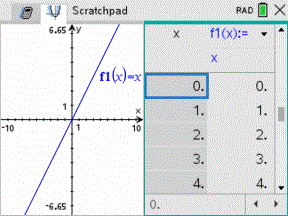
| ▶ | To hibernate the tabular array, click the graph side of the separate screen, and then press b > Tabular array > Remove Tabular array (b7ii). You can also printing Ctrl + T. |
| ▶ | To resize columns, click the table and press b > Deportment > Resize (b1i). |
| ▶ | To delete a cavalcade, edit an expression, or edit tabular array settings, click the tabular array and press b > Table (b 2). |
Irresolute the Appearance of the Axes
As you work with graphs, the Cartesian axes are displayed past default. You can change the appearance of the axes in the following ways:
| 1. | Press b4 and choose the Zoom tool to use. |
| ii. | Select the axes and press /btwo to activate the Attributes tool. |
| a) | Printing £ or¤ to move to the attribute to alter. For case, choose the cease manner attribute. |
| b) | Printing ¡ or¢ to cull the mode to apply. |
| c) | Change whatsoever other attributes of the axes as required for your piece of work, and then press · to exit the attributes tool. |
| three. | Adapt the axes scale and tic mark spacing manually. |
| a) | Click and hold one tick mark, and move information technology on the centrality. The spacing and number of tic marks increases (or decreases) on both axes. |
| b) | To adjust the scale and tic mark spacing on a single centrality, press and hold yard, and then grab and drag a tic marking on that axis. |
| iv. | Modify centrality end values past double-clicking them and typing new values. |
| 5. | Adjust the location of the axes. To motility the existing axes without resizing or rescaling them, click in and elevate an empty region of the screen until the axes are in the desired location. |
| 6. | Change the axes' scales by pressing b > Window/Zoom > Window Settings (b41). |
Blazon the values of your choice over the current values for x-min, x-max, y-min, y-max, Xscale, and Yscale and click .
| seven. | Printing b > View > Hibernate Axes (btwoane) to hibernate or show the axes. |
| • | If the axes are shown on the page, selecting this tool hides them. |
| • | If the axes are hidden on the page, selecting this tool redisplays them. |
Tracing a Plot
Graph Trace moves through the points of a graphed function, parametric, polar, sequence, or scatter plot. To enable the trace tool:
| 1. | Press b > Trace > Graph Trace (b5ane) to movement across the plot in Trace fashion. |
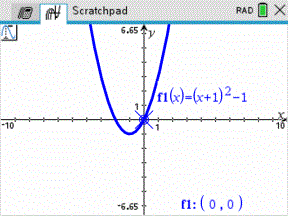
| 2. | (Optional) To alter the trace step increment for tracing, press bfive3. |
After yous type a dissimilar footstep increase, the Graph Trace tool moves beyond the graph in steps of that size.
| 3. | Use Graph Trace to explore a plot in the following ways: |
| • | Move to a signal and hover to move the trace cursor to that bespeak. |
| • | Printing ¡ or¢ to move from indicate to point on the office'due south graph. The coordinates of each signal traced are displayed. |
| • | Press £ or¤ to motion from one plot to another. The point'due south coordinates update to reverberate the new location of the trace. The trace cursor is positioned on the betoken of the new graph or plot with the closest x value to the last point identified on the previously traced office or graph. |
| • | Type a number and printing · to motility the trace cursor to the point on the plot with independent coordinates nearest the typed value. |
| • | Create a persistent betoken that remains on the graph by pressing · when the trace point reaches the bespeak you desire to label. The betoken remains later y'all exit Graph Trace mode. |
Notes:
| • | The string undef is displayed instead of a value when you motility over a point that is non divers for the function (a discontinuity). |
| • | When y'all trace beyond the initially visible graph, the screen pans to show the area being traced. |
| iv. | Press d or cull some other tool to exit Graph Trace. |
Finding Points of Involvement
You can use the tools on the menu to discover a signal of involvement in a specified range of any graphed function. Choose a tool to find zero, the minimum or maximum, the betoken of intersection or inflection, or the numeric derivative (dy/dx) or Integral on the graph.
| 1. | Select the point of involvement that you want to find on the Analyze Graph card. For example, to discover a zippo, press bvi1. |
| not-CAS and Exact Arithmetics | CAS | |
|---|---|---|
| Aught | b61 | bvi1 |
| Minimum | b62 | b6two |
| Maximum | bhalf-dozenthree | b63 |
| Intersection | b64 | bhalf dozenfour |
| Inflection | Not applicable | b6v |
| dy/dx | b6five | bhalf-dozenhalf-dozen |
| Integral | bvi6 | b67 |
| Analyze Conics | bhalf dozen7 | b68 |
The icon for the selected tool is displayed at the meridian left on the work area. Point to the icon to view a tooltip about how to utilise the selected tool.
| 2. | Click the graph you want to search for the indicate of interest, and so click a second time to signal where to kickoff the search for the point. |
The 2nd click marks the lower jump of the search region and a dotted line is displayed.
Note: If you are finding the derivative (dy/dx), click the graph at the point (numeric value) to use for finding the derivative.
| 3. | Press ¡ or ¢ to move the dotted line that marks the search region, and then click the indicate at which you want to terminate the search (upper bound of the search region). |
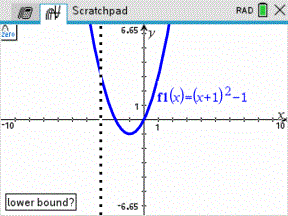
| four. | Press · at the point to beginning the search. The tool shades the range. |
If the search region you lot specified includes the point of involvement, a label for the point is displayed. If you change a graph that has points of interest identified, exist sure to check for changes in points of interest. For example, if you edit the office on the entry line or manipulate a plot, the point where the graph intersects zero can modify.
The labeled points of interest remain visible on the graph. You can exit the tool past pressing d or choosing another tool.
Source: https://education.ti.com/html/webhelp/EG_TINspire/EN/content/m_scratchpad/sc_graphing_with_the_scratchpad.HTML
0 Response to "How To Clear Scratchpad On Ti-nspire Cx"
Post a Comment